One of the first questions almost every coloring book creator asks is:
"How many pages should my coloring book have?"
The answer is simple:
There is no perfect page count that works for every coloring book.
The right number depends on who your book is for, how people will use it, and where you plan to publish it.
A toddler coloring book, an adult relaxation coloring book, an Etsy printable, and an Amazon KDP paperback all have different requirements.
Many beginners make the mistake of thinking:
More pages = more value.
But page count is only one part of the experience.
A successful coloring book is not the longest one. It is the one that feels complete, consistent, and enjoyable from the first page to the last.
In this guide, we'll explore how to choose the right page count based on your audience, publishing method, and creative goals.
Is There an Ideal Number of Pages for a Coloring Book?
Not really.
Instead of looking for one magic number, think about what your coloring book is trying to accomplish.
Ask yourself these questions:
Who is the book for?
Will people print it at home or buy a physical copy?
Is it a one-time activity or something they can enjoy over multiple sessions?
Can you maintain the same quality across every page?
These factors matter far more than simply aiming for 100 pages.
A shorter coloring book with thoughtful illustrations usually creates a better experience than a long book filled with repetitive artwork.
Recommended Coloring Book Page Counts
If you're looking for a starting point, these ranges work well for most projects.
Coloring Book Type | Recommended Pages |
Toddlers (Ages 2–4) | 20–25 |
Preschool & Kindergarten | 25–35 |
Kids (Ages 6–10) | 30–50 |
Adult Coloring Books | 40–80 |
Classroom Activity Books | 20–40 |
Printable PDF (Etsy) | 25–50 |
Amazon KDP Paperback | 40–80 |
These aren't strict rules—they're practical guidelines based on how coloring books are typically created and used.
If you're making your first coloring book, 30–40 pages is usually the sweet spot.
It gives readers enough variety without making the project overwhelming to create.
What Actually Determines the Right Page Count?
Rather than copying another creator's book, consider the factors below.
1. Your Audience
Different audiences have very different expectations.
Young Children
Young children usually finish coloring pages quickly.
Large shapes, simple illustrations, and shorter books help keep them engaged without becoming repetitive.
Around 20–30 pages is often enough.
Older Kids
Elementary-age children enjoy more variety.
They'll usually appreciate books with:
Different scenes
Multiple characters
Gradually increasing detail
A range of 30–50 pages works well for most themes.
Adults
Adult coloring books are designed for relaxation.
Each page typically takes much longer to complete.
That means readers don't necessarily need 100 illustrations.
A carefully designed 40–60 page book often provides weeks of enjoyment.
2. Your Publishing Method
Where people use your coloring book also affects the ideal length.
Printable PDFs
Printable coloring books downloaded from Etsy or your own website tend to perform well with 25–50 pages.
Why?
Because buyers often want something they can print immediately without using excessive ink or paper.
Smaller files also download faster and are easier to store.
Amazon KDP
Paperback coloring books generally contain more pages.
Many successful KDP books fall between 40 and 80 pages because readers expect a physical book to feel substantial.
Remember that Amazon has printing requirements and production costs that can influence your final page count.
Classroom Use
Teachers usually don't need an 80-page coloring book.
Instead, they prefer shorter collections that fit a lesson or seasonal activity.
Twenty to thirty pages is often more practical.
Does More Pages Mean More Value?
This is probably the biggest misconception among new creators.
No.
Adding pages only increases value when each page offers something new.
Imagine these two books.
Book A
100 pages
Many repeated poses
Similar backgrounds
Nearly identical layouts
Book B
40 pages
Every illustration feels unique
Balanced difficulty
Consistent art style
Carefully planned progression
Most readers would choose Book B.
Quality beats quantity almost every time.
My Biggest Observation After Comparing Popular Coloring Books
One pattern appears again and again.
The most successful coloring books rarely try to include everything.
Instead, they stay focused.
A dinosaur coloring book doesn't suddenly introduce unicorns halfway through.
A farm animal book doesn't switch to outer space.
Every page reinforces the same theme, making the book feel intentional rather than random.
Interestingly, many popular coloring books on Amazon and Etsy fall within a similar range of roughly 30 to 60 coloring pages.
That's enough to provide variety while still maintaining consistent quality.
This isn't a rule—but it's a useful benchmark if you're creating your first book.
Real Examples: How Many Pages Do Popular Coloring Books Have?
Numbers are helpful, but real examples reveal a clearer picture.
To better understand what page counts work in the real market, I analyzed 10 popular coloring books on Amazon across different categories, including adult coloring books, kids' coloring books, themed collections, and educational coloring books.
Before looking at the numbers, there is one important detail to understand:
A coloring book's total print length is not always the same as the number of coloring designs inside.
Many coloring books use single-sided printing, blank backing pages, title pages, or other formatting choices. Because of this, a book with 100 coloring designs may have more than 200 printed pages.
For this analysis, I separated two important metrics:
Unique Coloring Designs: The actual number of individual illustrations users can color.
Amazon Print Length: The total number of pages shown in the Amazon product listing.
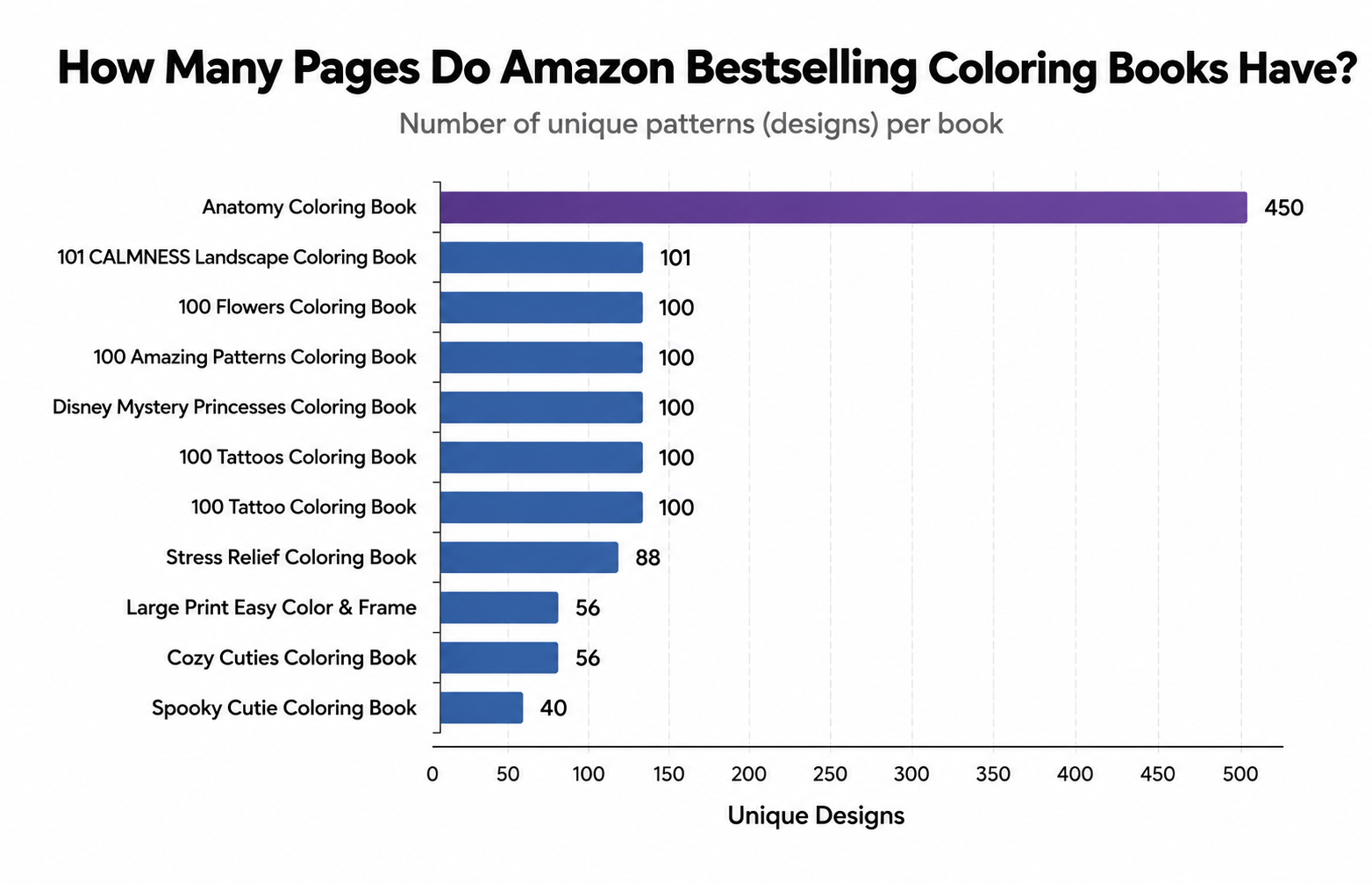
Rank | Coloring Book | Unique Coloring Designs | Amazon Print Length | Target Audience |
1 | 100 Flowers Coloring Book | 100 | 206 | Adult flower coloring & relaxation |
2 | 100 Amazing Patterns Coloring Book | 100 | 206 | Adult mandala & geometric patterns |
3 | Cozy Cuties Coloring Book | 45 | 96 | Cute characters for all ages |
4 | Stress Relief Coloring Book | 88 | 182 | Adult mindfulness & stress relief |
5 | Large Print Easy Color & Frame | 56 | 120 | Seniors and easy-coloring users |
6 | 101 CALMNESS Landscape Coloring Book | 101 | 207 | Adult relaxing landscape coloring |
7 | Spooky Cutie Coloring Book | 40 | 112 | Cute Halloween-style coloring |
8 | Disney Mystery Princesses Coloring Book | 100 | 128 | Kids' coloring and activity book |
9 | Anatomy Coloring Book | 450+ | 192 | Medical students and educational learning |
10 | 100 Tattoos Coloring Book | 100 | 178 | Adult tattoo-inspired designs |
Data collected from Amazon product listings. Page counts may vary depending on edition, format, and updates.
What Does This Data Tell Us?
The biggest takeaway is simple:
There is no universal "perfect" page count for a coloring book.
Successful coloring books follow different strategies depending on their audience and purpose.
Model 1: More Designs, Longer Coloring Experience
Some books create value by providing a large number of individual coloring opportunities.
Examples:
100 Flowers Coloring Book
100 Amazing Patterns Coloring Book
101 CALMNESS Landscape Coloring Book
These books work well because users receive many different designs to explore.
For adult coloring books, having 80–100+ unique designs can make sense because each page represents a longer relaxation activity.
Model 2: Fewer Designs, Stronger Theme and Style
Not every successful coloring book needs 100 pages.
Examples:
Cozy Cuties Coloring Book
Spooky Cutie Coloring Book
These books succeed because of:
recognizable characters
consistent illustration style
emotional connection
strong visual identity
A smaller collection can still feel valuable when every page belongs together.
Model 3: Specialized Purpose Matters More Than Page Count
The Anatomy Coloring Book is a perfect example.
With 450+ designs, its value doesn't come only from the number of pages.
Its purpose is different:
education
memorization
interactive learning
For specialized coloring books, usefulness matters more than simply adding more illustrations.
The Lesson for New Coloring Book Creators
After analyzing these examples, one thing becomes clear:
The goal is not to create the longest coloring book. The goal is to create the right coloring experience for your audience.
A 40-page coloring book with consistent artwork and thoughtful design can provide more value than a 100-page book filled with repetitive illustrations.
This is especially important for AI-generated coloring books.
AI makes it easy to create hundreds of pages, but quantity alone does not create a successful product.
Consistency, theme, and user experience matter much more.
How Many Pages Should an AI Coloring Book Have?
AI makes it incredibly easy to generate hundreds of coloring pages.
That convenience creates a new problem.
Many creators generate far more pages than they actually need.
More pages don't automatically create a better coloring book.
In fact, longer AI-generated books often suffer from:
Inconsistent illustration styles
Changing line thickness
Repeated ideas
Uneven page quality
My recommendation is simple.
Start with 30 carefully selected pages.
If readers enjoy the theme, create:
Volume 2
Holiday editions
Seasonal collections
Advanced versions
It's much easier to build a successful series than one enormous book.
What Counts as a Page?
This question comes up frequently, especially for creators publishing through Amazon KDP.
Depending on your project, your book may include:
Cover
Title page
Copyright page
Coloring pages
"This book belongs to..." page
Blank backing pages (optional)
Thank-you page
The exact structure depends on how your book will be printed.
For printable PDFs, many creators include only the coloring pages.
For physical books, adding a few front and back matter pages creates a more polished, professional experience.
Common Mistakes First-Time Creators Make
Making the Book Too Long
AI can generate pages in seconds.
That doesn't mean every page belongs in the final book.
If two illustrations feel almost identical, choose the stronger one.
Prioritizing Quantity Over Consistency
Readers notice consistency far more than page count.
Using one cohesive illustration style throughout the book creates a much more professional result.
Repeating the Same Composition
If every page places the subject in the center with the same layout, the book quickly becomes predictable.
Vary the perspective, background, and composition while keeping the overall style consistent.
Never Printing a Sample
A coloring page that looks great on screen may not print well.
Before publishing, print several sample pages and check:
Line thickness
Margins
Image clarity
Coloring space
Overall balance
Testing your work is one of the easiest ways to improve the final product.
Free Coloring Book Creation Planner
Creating a coloring book becomes much easier when you plan the structure before creating illustrations.
Many beginners start generating pages immediately and only later realize:
the theme is unclear
the page count is inconsistent
the illustrations don't feel connected
A simple planning worksheet can help you stay organized from the beginning.
Download our free Coloring Book Creation Planner PDF and use it to plan:
Your book concept
Target audience
Page goals
Printing preparation
Quality checks
What's Included in the Planner?
Basic Book Information
Coloring Book Title:
Theme & Art Style:
Book Concept / Main Idea:
Target Audience:
☐ Toddler
☐ Kids
☐ Teen
☐ Adult Relaxation
Usage Purpose:
☐ Personal Hobby
☐ Classroom Activity
☐ Gift
☐ Etsy Printable
☐ Amazon KDP Paperback
Page Planning
Total Planned Coloring Pages:
Completed Pages:
Remaining Pages:
AI Generated Pages Reviewed:
☐ Single-sided layout
Paper Size:
☐ US Letter 8.5 × 11
☐ Square 8 × 8
☐ A4
Production Checklist
☐ Test printed sample pages
☐ Check marker bleed-through
☐ Add black backing pages (anti-bleed)
☐ Check line thickness and coloring spaces
☐ Verify consistent illustration style
☐ Cover art finished
☐ KDP margin settings confirmed
Notes & Modifications:
A great coloring book starts with a clear plan.
Before creating dozens of illustrations, take a few minutes to define your theme, audience, and production goals.
Frequently Asked Questions
Can a coloring book have only 20 pages?
Absolutely. A 20-page coloring book can work well for toddlers, classrooms, seasonal activities, or printable downloads. The key is providing enough variety without unnecessary repetition.
What's the best page count for Amazon KDP?
Many KDP coloring books contain between 40 and 80 pages, but the ideal length depends on your audience, production costs, and the complexity of your illustrations.
Should every page contain a coloring illustration?
Not necessarily. Physical books often include front matter such as a title page or copyright page. Printable PDFs are usually simpler and may contain only the coloring pages.
Is it better to publish one 100-page book or two 50-page books?
In many cases, two focused 50-page books provide a better user experience than one oversized collection. They also make it easier to create themed series and encourage repeat purchases.
Does a higher page count increase sales?
Not by itself. Buyers care more about the quality, consistency, and uniqueness of the illustrations than the total number of pages.
Final Thoughts
There isn't a universal page count that works for every coloring book.
The right number depends on who you're creating for, how the book will be used, and whether you can maintain consistent quality from beginning to end.
If you're creating your first coloring book, 30–40 thoughtfully designed pages is an excellent place to start. It's enough to provide variety without sacrificing consistency or becoming overwhelming to produce.
As your skills improve, you can always expand into larger collections or themed series.
And remember: people don't recommend coloring books because they have the most pages—they recommend the ones that are the most enjoyable to color.
If you're using AI to create your illustrations, tools like ColorByte AI can help you generate consistent, print-ready coloring pages more efficiently. Just remember that the best coloring books aren't built by generating more pages—they're built by carefully choosing the right ones.